William Blake, St. Mary's Church Battersea
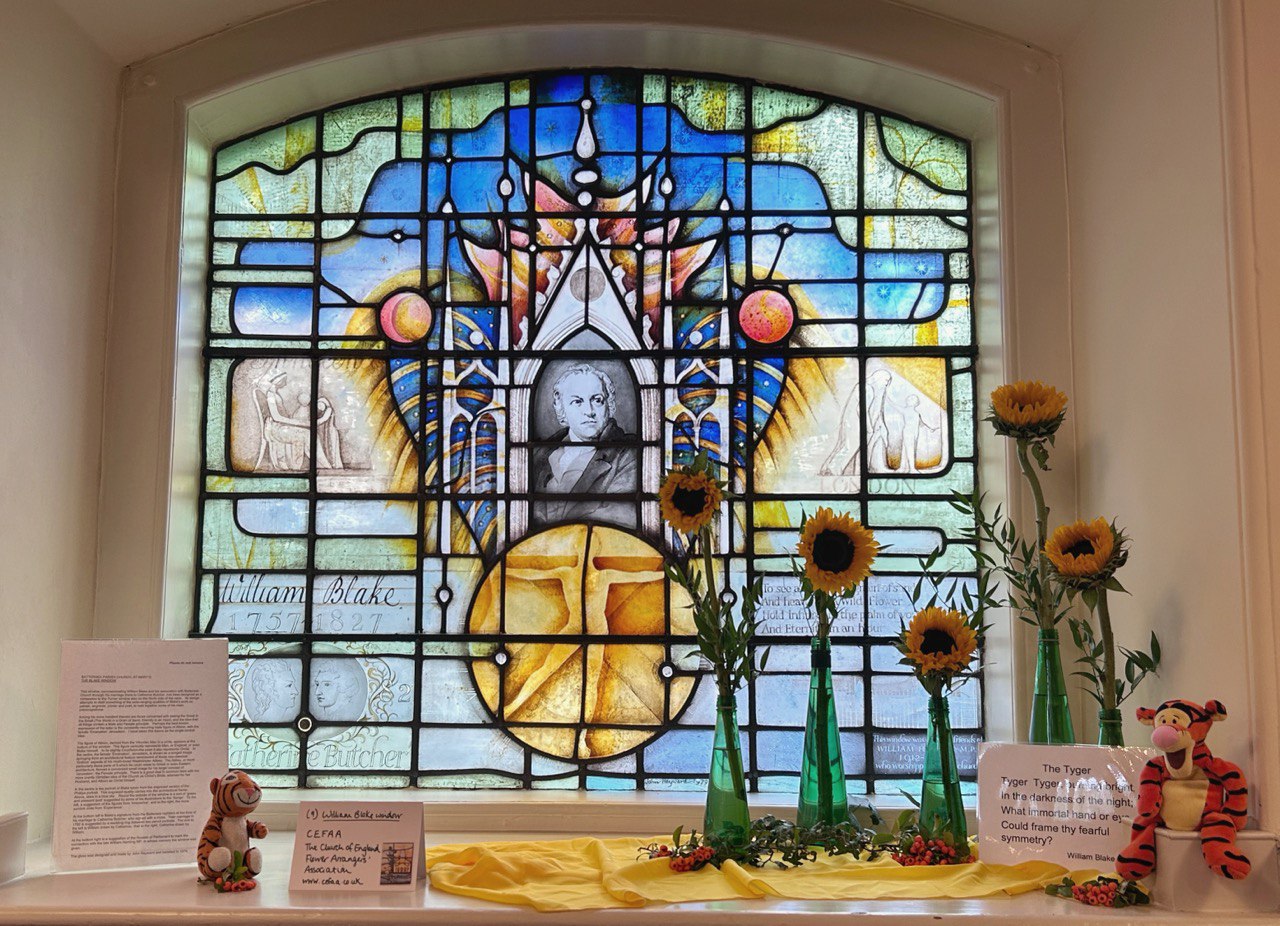
To quote the church guide:
The artist, engraver and poet William Blake was married to Catherine Boucher in the church in 1782. It surprises many to learn that the wife of one of our greatest poets was illiterate, and could only made her mark with a cross in the wedding register. The wedding is suggested by a wedding ring between two pencil portraits. The one of the left is William drawn by Catherine, the one on the right, Catherine as drawn by William. The rest of the window design attempts to give expression to the diversity of Blake’s talents as a painter, engraver, printer and poet. Among his more insistent themes are those concerned with seeing the great and the small and the idea that all things contain a male and female principle.
The stained glass shown above is relatively new, dating from the second half of the 20th century. As the (extremely helpful!) website of the church explains, it owes its existence to the Blitz — and, even more, to the vicar’s discontent with the previous decorating choices (speaking of which: how many tiny details, like a toy tiger, have you seen?).
Between 1976 and 1982 four new stained glass windows were added to the ground floor of the Church. They commemorate some of the famous people associated with the church. In each case they were made by John Hayward of Edenbridge, Kent.
The glass on the ground floor had been plain since the 1940s. Stefan Hopkinson, the Vicar of Battersea during the Second World War, knew how to find the silver lining in every cloud.
He writes in his memoirs, Encounters: “Among the improvements in the church’s interior decoration is one other with which I am rather proud to be associated. When we arrived [in the parish] the ground floor windows were filled with very bad Victorian stained glass, which was not only ugly in itself, but excluded the daylight. But the air raids began, and one morning a bomb fell nearby. I went to investigate. There was considerable damage, but the church was unharmed — at least, until I picked up a stone and smashed all the Victorian glass.”
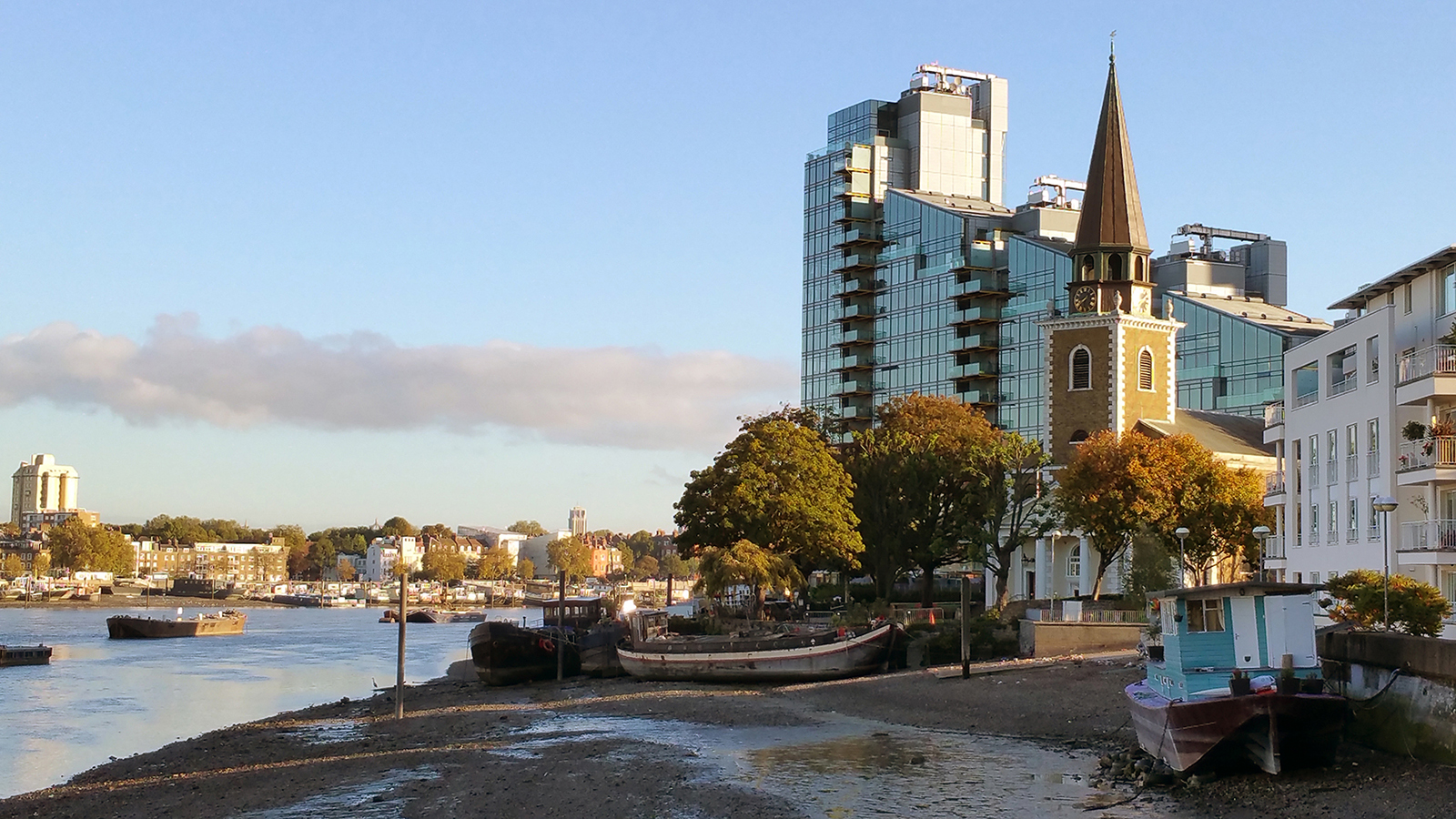
Note that what appears to be a sandy riverbank is, during the high tide, the bottom of the river covered with water all the way to the embankment's wall (hence the moored boats).
Because of its tidal nature, the level of the Thames changes dramatically throughout a day, with two extreme low points and two extreme high points every 24 hours.
In this riverside church with an active community, from the windows and doors of which one can see the tidal waters of the Thames, I volunteered as a guide during the Open House festival with my friend from the Tower.
Before that, I attended a service (it's always interesting to see life "in action" before focusing on stories) — and, after that, a concert of the London Vegetable Orchestra.
All in one place. In one day.
(It’s a different performance, but it can bring some flavour of what’s happening).
I didn’t have the king in my party, still, I tried to tempt a proper — within working hours, bearskin-wearing — musician to convert to carrots or peppers.
London's eccentricity never ceases to amaze me.
I guess, I try to match: for this volunteering engagement, I decided to wear my petticoat and DID NOT decide to be barefoot, only in my socks — but I was.
The bottom of the river was so wonderfully exposed during the low tide before my shift that I simply needed a stroll in the mud — that rendered wearing trainers within the church completely inappropriate.